
The History of Ceramic Tiles
An Architectural Material from the Past to the Present
Ceramic floor and wall tiles, which are commonly used today in homes, hotels, shopping centers, and commercial spaces, are actually a building material with a history dating back thousands of years. Ceramic tiles are not merely a decorative product; they are an important architectural cladding solution that offers durability, hygiene, and long-lasting use.
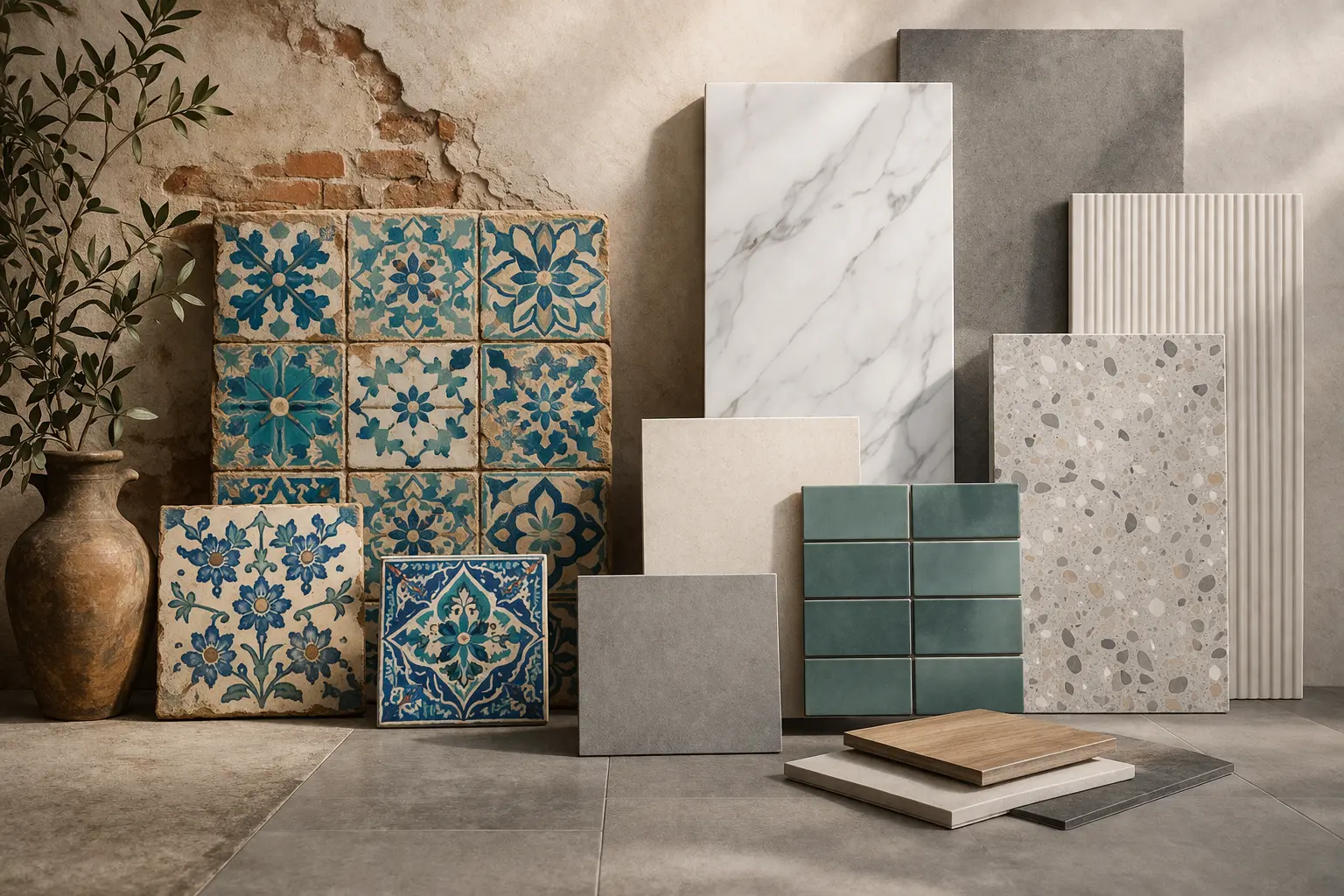
The First Ceramic Tiles
The earliest examples of ceramic tiles can be found in Ancient Mesopotamia and Ancient Egypt. During these periods, fired clay tiles were used primarily to cover the walls of important buildings. The main reason for this was that fired clay was resistant to water, moisture, and heat.
Over time, these tiles began to be used not only for protection but also for decorative purposes, and ceramic surfaces were adorned with various patterns and colors. Thus, ceramics became both a technical and an aesthetic material in architecture.
Ancient Rome played a significant role in the development of ceramic floor tiles. The Romans used mosaics made of ceramic and stone pieces as floor coverings. These mosaics were both durable and long-lasting.
Used in bathhouses, villas, and public spaces, these floor coverings facilitated the widespread adoption of ceramic tiles in architecture and laid the foundation for the concept of ceramic floor coverings.
The Development of Turkish Ceramic Tiles
The production of ceramic tiles among the Turks has seen significant development, particularly in Anatolia. Ceramic tiles produced in Anatolia have been used in architectural structures as wall coverings, floor coverings, and decorative surface finishes.
Over time, Turkish ceramic producers succeeded in manufacturing durable, colorfast tiles with glazed surfaces and a long lifespan. Patterned tiles, particularly those featuring geometric motifs and botanical designs, have been widely used on architectural surfaces.
This production tradition has evolved over time to form the foundation of today’s modern ceramic tile production. Today, Turkey ranks among the world’s leading producers of ceramic tiles.
The Industrial Revolution and Modern Ceramic Tiles
With the Industrial Revolution, ceramic tile production shifted from handcrafted methods to factory-based production. With the development of pressing machines, high-temperature kilns, and glazing techniques, manufacturers began producing more durable tiles in standard sizes.
In the 20th century, various types of tiles—such as porcelain tiles, granite ceramic, and glazed ceramic—were developed, and their applications rapidly expanded. Ceramic tiles are now used not only in interior spaces but also on exterior facades and in industrial settings.
Ceramic Floor and Wall Tiles Today
Today, ceramic tiles are one of the indispensable cladding materials in architecture. The main reasons for this are as follows:
- Water- and moisture-resistant
- Easy to clean and hygienic
- Abrasion-resistant
- Durable
- Fire-resistant
- Available in a wide variety of sizes, colors, and textures
- Can be produced with the appearance of wood, marble, concrete, and stone
Thanks to advancing technology, large-format tiles, thin ceramic tiles, outdoor tiles with non-slip surfaces, and facade cladding tiles are now being produced.
Ceramic tiles originated thousands of years ago as fired clay slabs and have evolved over time to become one of the most important cladding materials in modern architecture. Thanks to their durability, aesthetic versatility, and long-lasting nature, ceramic tiles remain an indispensable solution in modern buildings from both a technical and design perspective.